And if I add my Fractal Based trading strategy to the FVG trading strategy....
### Comprehensive Fractal-Based M15 Trading Strategy with EMA Crosses and Fair Value Gaps (FVGs)
This strategy merges the simplicity of baselines, dynamic EMA cross signals, and the concept of Fair Value Gaps (FVGs) to provide a robust intraday trading method. Here's a detailed, neat package that you can implement effectively.
### Key Strategy Components
1. **Define Major Support/Resistance:** Identify significant High/Low pivot levels using the Square Semaphore (576).
2. **Baseline Confirmation:** Wait for the 2nd Dot (36) after the Square to confirm the trend and establish a Baseline.
3. **Trade Execution:**
- Trade Small (9), Mid (36), and Large (144) 2nd Dots off the Square Baseline in the direction indicated by the new Square.
- Continue these trades until a new Square is formed, signaling the end of the current cycle.
4. **EMA Cross for Dynamic Direction:** Use the cross of EMA 55 and EMA 13 to dynamically determine trade direction.
5. **Risk Management:** Apply physical stops at major pivot levels and virtual stops at minor pivot levels to protect trades and funds.
6. **Identify and Trade FVGs:** Recognize FVGs to layer in trades and use previous gaps as trailing stops.
### Step-by-Step Execution Process
### Phase 1: Identifying Major Support/Resistance and Establishing Baselines
#### 1.1 Chart Configuration
- **Timeframe:** M15
- **Indicators:**
- Semaphore: 9, 36, 144, 576
- EMAs: 55 and 13
#### 1.2 Identifying Key Semaphore Signals
- **Square Semaphore (576):** Identify these on the M15 chart to note significant support/resistance and potential major trend reversals.
- **Wait for 2nd Dot (36):** This forms the Baseline, confirming the potential trend change.
### Phase 2: Determining Trade Direction with EMA Cross and Executing Trades
#### 2.1 EMA Cross as Confirmation
- **Bullish Cross:** EMA 13 crosses above EMA 55 indicates an uptrend.
- **Bearish Cross:** EMA 13 crosses below EMA 55 indicates a downtrend.
#### 2.2 Executing Trades Based on 2nd Dots
- **Small (9), Mid (36), and Large (144) Dots:** Enter trades in the direction of the new Square once the Baseline is established and confirmed by EMA crosses.
- **Continue trading these Dots:** Until a new Square Semaphore (576) forms, signaling the end of the current cycle.
### Phase 3: Additional Trade Layering Using FVGs
#### 3.1 Identifying Fair Value Gaps (FVGs)
- **Objective:** Identify areas where price moved rapidly due to supply and demand imbalances.
- **Custom Indicator:** Use an MQL4 script to scan for FVGs based on large percentage moves relative to ATR and significant volume spikes.
- **Volume Profile:** Highlight low-volume nodes indicating potential FVGs.
#### 3.2 Layering Trades in FVGs
- **Bullish FVG:** Place Buy Limit orders within the gap area.
- **Bearish FVG:** Place Sell Limit orders within the gap area.
- **Risk Management:** Each trade has a stop-loss just outside the FVG to limit potential losses.
### Phase 4: Using Previous Gaps as Trailing Stops
#### 4.1 Managing Trades
- **Initial Stops:** Apply physical stops at major pivot levels (Square Semaphore) and virtual stops at minor pivot levels (2nd Dots).
- **Trailing Stops:** As price moves in your favor, adjust your stop-loss orders to the boundaries of previous unfilled FVGs to capture profits and limit losses.
### Example Trading Workflow
#### Scenario: Trading JP225 with Baseline, EMA Crosses, and FVGs
1. **Identify Major Support/Resistance:**
- Spot a Down Square (576) on JP225, marking a major resistance pivot level.
- Wait for a 2nd Dot (36) to establish the Down Square Baseline.
2. **Confirm Direction with EMA Cross:**
- EMA 13 crosses below EMA 55, confirming the downtrend.
3. **Execute Trades Off 2nd Dots:**
- Enter trades at new 2nd Dots (9) in the direction of the Square Baseline and confirmed by the EMA cross.
- Apply physical stops above the Square (576) resistance and virtual stops at minor pivot levels.
4. **Identify and Layer Trades in FVGs:**
- Use MQL4 script and Volume Profile to identify FVGs in the downtrend.
- Place Sell Limit orders at multiple levels within the FVG area with stop-losses outside the gap.
5. **Use Previous Gaps as Trailing Stops:**
- Adjust stop-loss levels to the boundaries of previous unfilled FVGs as the price continues downward.
6. **Cycle Completion and Repetition:**
- Once a new Square forms signaling a trend change, repeat the process with the new trend direction.
- Shift focus to identifying new major support levels and applying the same disciplined approach.
### Summary
1. **Identifying Major Levels:**
- Use Semaphore (576) to define major support/resistance.
2. **Waiting for Baseline Confirmation:**
- Establish Baseline with 2nd Dot (36) after the Square.
3. **Dynamic Trade Direction:**
- Use EMA 13 and EMA 55 crosses to confirm trade direction.
4. **Executing Trades:**
- Enter trades at Small (9), Mid (36), and Large (144) Dots in the Baseline direction.
5. **Layering Trades in FVGs:**
- Identify FVGs and place orders within these zones.
6. **Risk Management:**
- Apply physical and virtual stops to protect trades.
7. **Trailing Stops:**
- Use previous FVG boundaries for trailing stops to secure profits.
This comprehensive, refined strategy harmoniously integrates clear trade signals from Semaphore, dynamic EMA cross confirmations, and disciplined trade management using FVGs. This approach ensures clarity, precision, and robust risk management, paving the way for capturing significant and consistent pip gains. Happy trading!
Xard777
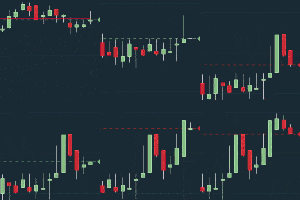
OK this is a one minute TF but you get the picture.
Thanks to Samoth for the FVG indicator and color set.
Attachments forums
Re: XARD - Simple Trend Following Trading System
xard777, Sun Jul 14, 2024 2:25 am
 Zelensky’s prosecutors arrested for corruption.

 10/09 15:15 EUR Main Refinancing Rate 15:30 US